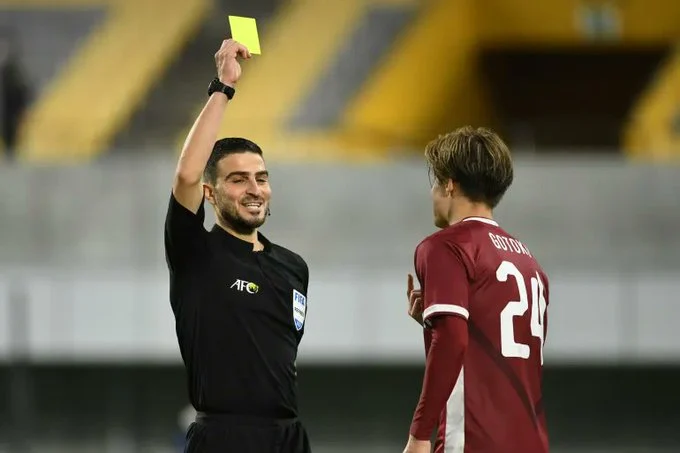
Referee Hanna Hattab: Judged Before Anyone Asked
One case, and three questions that no one has answered yet
By Dr. Talal Othman, General Manager, GCC Sport
In football, a player can be sent off with a card. A coach can be punished by a disciplinary decision. But for a referee, one angry statement is sometimes enough to condemn him in public. That happens with no investigation, no evidence and no right of reply. This is what happened to the Syrian international referee Hanna Hattab in Abu Dhabi. The match was Al Jazira (UAE) against Gol Gohar (Iran), on matchday 5 of the AFC Champions League Two.
Al Jazira won 1-0. But the real story was not on the scoreboard. It started in the referees’ room at half-time, and it continued in the Iranian media.
1. What actually happened?
There are few confirmed facts, and we must start with them. In the 32nd minute, Hattab showed a yellow card to the Al Jazira goalkeeper. The goalkeeper had no part in the foul. Then the referee cancelled the decision. This was a clear error in identifying the offender. Nobody disputes that.
But the professional question is this: is such an error rare? No. Referees misidentify offenders in top leagues, in continental competitions and even at the World Cup. A referee who sees his mistake and corrects it at once does exactly what the Laws of the Game require. He changes his decision before play restarts. That correction is not a sign of confusion. It is a sign of awareness.
2. Why was the referee replaced?
Here the facts become unclear. The Asian Football Confederation has not yet given an official reason for the change. With no official account, one story filled the gap: the story of the losing side.
We know that Gol Gohar officials threatened not to complete the match if Hattab stayed in charge. When a team makes such a threat, the match commissioner has two options. He can risk a match that does not finish. Or he can bring in the fourth official so that the match continues. He chose the second option. The Syrian referee Ammar Abu Alou took charge of the second half, and Hattab stayed on as fourth official.
That last detail is very important. If the officials had found Hattab unfit to work, he would not have stayed on the touchline as fourth official. A fourth official manages substitutions, talks to the referee and supervises the technical areas. His presence in the team says a lot. Most likely, the decision was made to control the crisis and save the match. It was not a verdict on the man.
3. Was he under the influence of alcohol?
There is no published evidence of this. There is no test, no medical report, no AFC statement and no neutral witness. There is only an accusation from the losing side, reported by media in that club’s own country.
In law and in sport, the person who makes an accusation must prove it. To accuse an international referee of officiating a continental match while drunk is to accuse him of a professional offence that can end his career. An accusation of that size does not belong in a half-time outburst. It belongs with the correct authority, together with the evidence, and that authority must investigate it.
The Gol Gohar officials did the opposite. They made the accusation in public. They made the removal of the referee a condition for continuing the match. In this way, they used pressure to change the referee. If Asian football accepts this method without consequences, it opens a dangerous door. Any team that is losing can accuse the referee of anything and then threaten to leave the pitch.
4. Who insulted the referee?
The insult was not the wrong yellow card. The insult came from 3 things:
1. An accusation with no evidence. Someone published a claim against the professional and personal honour of a man who nobody called or questioned.
2. An attack on his private life. Hattab said this himself in his statement: family and personal life are not other people’s responsibility, and they are not a game in other people’s hands. These are the words of a man who felt that the attack went past the pitch and into his home.
3. Irresponsible media coverage. Many outlets reported the accusation as news, not as a claim from a side that lost. Here, Arab sports media must accept its responsibility first. When the media repeats a claim without checking it, it gives the claim a legitimacy that it does not deserve.
This is why Hattab’s position is logical and balanced. He did not start an argument. He did not reply in anger. He reserved his full legal right to act against anyone who published, stated or helped to spread the insults, whether a person, an institution or a sports body. He also said that he will wait for the official position of the Syrian Football Association before he gives a detailed statement. This is the conduct of a professional. He knows that the real fight is won in institutions, not on Facebook.
5. Where is the AFC? Where is the Syrian FA?
The silence is the biggest problem.
The AFC must do 2 clear things. First, it must publish an official statement that explains the change of referee. That statement must say if the decision was about the referee’s condition or about the Iranian team’s threat. Second, it must open a disciplinary case on Gol Gohar’s threat not to complete the match, and on the public accusations against an AFC-approved referee. If the accusation is true, the AFC must show the evidence. If it is not true, the AFC must protect its referee. A referee whose confederation does not protect him will not dare to make a difficult decision the next time.
The Syrian Football Association must do even more. Hattab is not an ordinary referee. He is one of the few faces that represent Syrian refereeing in continental competitions. To defend him is not a favour. It is a defence of the reputation of all Syrian refereeing. The Syrian FA must make a public statement, send an official request to the AFC for an explanation, and give legal support if the referee decides to sue the people who defamed him.
Conclusion
Hanna Hattab may have made a mistake in the 32nd minute. That is possible, and he corrected it. But what happened next was not criticism of a referee’s performance. It was a public trial with no judge and no evidence. The difference between criticism and defamation is the difference between a sport that respects its laws and a sport that lets the loudest voice decide the verdict.
Until the AFC speaks with evidence, Hattab is innocent of these claims. This is not emotion. This is a rule.
Dr. Talal Othman, General Manager, GCC Sport