Cricket Scotland announced on November 9 that it would stop arranging men's bilateral cricket with Afghanistan and would decline participation in three-team series involving the Afghan men's side under current conditions. It will continue to play fixtures against Afghanistan that are required under International Cricket Council competition rules. The policy also rules out Scottish involvement in pre-tour camps, practice matches and warm-ups outside ICC events. Cricket Scotland cited the treatment of women and girls in Afghanistan, broader humanitarian concerns and its own commitment to developing women's and girls' cricket. The board will review its position annually and can revisit it after a significant ICC decision or a material change in circumstances.
The announcement has immediate relevance in the United Arab Emirates. The Afghanistan Cricket Board is preparing a men's franchise league there, with a planned December 27 start and five squads assembled at a draft in Dubai. Scottish opener George Munsey was selected. The Scottish board's policy distinguishes that individual contract from fixtures it arranges for its national team. As Reuters and NDTV reported, a certificate permitting participation is conditional on the league receiving formal ICC sanction. The draft, the Scottish board's contractual obligations and the ICC's ruling on the competition are separate steps. An announcement in Dubai can establish who a franchise wants to sign and when it intends to play. It cannot settle whether that player is cleared to appear.
What the Scottish decision changes
Two approaches from the Afghan board prompted the review. In July it asked for access to Scottish training facilities before its men's series against Ireland. Cricket Scotland turned down the request because of operational constraints and to give its board time to assess the issue. The ACB approached Cricket Scotland again in September in connection with the Afghanistan Premier League. The Scottish board says its assessment drew on consultation with government, consideration of the humanitarian situation and its own priorities for expanding women's cricket. That sequence explains why the policy extends beyond deciding whether to put a Scotland–Afghanistan match on a calendar.
A board can provide a touring side with value without fielding its own national team. Access to a practice ground allows visiting players to prepare before they travel on to a different opponent. A practice fixture gives them competitive time that a net session cannot provide. A bilateral tour requires more extensive scheduling and hosting decisions. Under the November policy, Cricket Scotland is withdrawing from each of those forms of cooperation outside ICC events, while maintaining its place in matches determined by the governing body's regulations. That distinction places responsibility on the body that actually arranges the event. A tournament fixture comes from the competition structure. A privately scheduled training camp or three-team series depends on decisions made directly by the boards involved.
The practical change will be seen in which requests Scotland accepts in future. Reuters reported that the two sides had not met in a full international since the 2021 men's T20 World Cup, so the November announcement does not interrupt a regular bilateral series. It does create a formal answer to future invitations and access requests. Cricket Scotland said that reconsideration of bilateral and tri-series play would depend on a material change affecting Afghan women's cricket and wider human rights. The board also identified a significant ICC decision as a possible reason to review the wider policy. Its statement set out those triggers without promising any particular outcome at a future review.
Sharjah, Trinidad and Bengaluru explain the distinction
On October 25, 2021, Afghanistan beat Scotland by 130 runs in their T20 World Cup group match at Sharjah Cricket Stadium. Afghanistan scored 190 for four from 20 overs, with Najibullah Zadran contributing 59. Scotland were all out for 60 after 10 overs and two balls. That is a full international of the kind that could still be played under the new policy if the ICC schedule requires it. It also connects the story to the UAE independently of the franchise draft. Sharjah has already been the setting for a competitive Scotland–Afghanistan match in a global tournament.
The teams have met more recently in World Cup preparation. The ICC recorded a 55-run Afghan victory in the 2024 tournament warm-up in Trinidad. On February 2, 2026, they met in another official World Cup warm-up, in Bengaluru. Darwish Rasooli scored 84 from 46 balls as Afghanistan reached 184 for six, then Scotland were dismissed for 123 with three balls left in the innings. Afghanistan won by 61 runs. These matches are part of the relationship even though they are distinct from the full international in Sharjah. Cricket Scotland's wording means the status of a warm-up depends on whether it is part of an ICC event under its competition rules. A practice fixture arranged separately by the two boards falls on the other side of that policy.
Cricket Australia's practice provides an example of how the division can work. It postponed a planned men's T20 international series against Afghanistan in 2024 and cited deteriorating conditions for women and girls. Australia subsequently faced Afghanistan at the 2025 ICC Champions Trophy, where their group match in Lahore ended without a result after rain interrupted Australia's chase. Reuters also reported a similar distinction in England and Wales Cricket Board policy. These examples show that a team may decline a series it controls and still have Afghanistan as an opponent at a global event. The Scottish decision concerns the conduct of one board. Afghanistan's eligibility for ICC tournaments belongs to a different level of cricket governance.
The decision facing Munsey and the UAE league
The Afghan board announced that the November 3 Dubai draft filled out squads for five franchises. A league season scheduled to begin in the Emirates on December 27 represents a different kind of competition from the ICC World Cup. The players are selected by franchises, which can recruit overseas professionals, and the national boards may have to clear those players under their contracts. Munsey was the only Scottish cricketer selected, according to NDTV. That creates a specific test of Scotland's policy: the board has ruled out organising national-team cricket with Afghanistan outside ICC events while preserving the ability to fulfil its obligations to a contracted player if the league is formally sanctioned.
A no-objection certificate concerns the individual player's release to participate. The ICC's sanction concerns the competition itself. Both decisions matter to a Scottish player in a proposed overseas league. Cricket Scotland said that if it issues a certificate, it does not consider the player's participation an endorsement of the Afghan authorities or their policies. As of the reporting checked for this article, there was no public confirmation of ICC sanction for the league. The scheduled date therefore describes the organisers' plan. The selection of a player in a draft does not confirm that he will be available, and neither a franchise's squad announcement nor Scotland's stated position substitutes for the ICC decision.
There is also a distinction between how boards describe an administrative permission and how players affected by the restrictions see the event. Nahida Sapan, who captained the Afghanistan Refugee Women's XI on its tour of England, told the BBC's Stumped programme that Afghan women cricketers want overseas players to consider what taking part communicates while women and girls cannot play freely at home. That is a concern about how the league is received, alongside the administrative question of whether it can go ahead. Sapan's intervention brings the perspective of a cricketer who has continued playing in exile into a discussion that might otherwise be framed entirely around men's franchises and player contracts.
What the ICC can change
Afghanistan became a Full Member of the ICC alongside Ireland in June 2017, which made both countries eligible to play Test cricket. Afghanistan had already reached its first men's 50-over World Cup in 2015, when it defeated Scotland, and the 2024 men's T20 World Cup brought a first semifinal appearance. Those milestones are part of the country's cricket history. The question before national boards now is how they conduct relations with the Afghan board under conditions that have sharply narrowed the opportunities of women and girls. UN Women documented in August 2026 how restrictions on education, work and public life had intensified since the Taliban returned to power in 2021. Reuters reported that the Taliban authorities say their policies reflect their interpretation of Islamic law and local customs.
The earlier World Cup also shows why Scotland is part of Afghanistan's cricket history. In Dunedin in 2015, Scotland made 210 and reduced Afghanistan to 97 for seven in the chase. Samiullah Shenwari made 96 to keep Afghanistan in contention. After the ninth wicket fell at 192, Hamid Hassan and Shapoor Zadran completed the chase with three balls to spare, giving Afghanistan its first win at a 50-over World Cup. The result predates Afghanistan's Test eligibility and came in a tournament both sides had reached before the 2017 membership decision. Afghanistan's relationship with Scotland therefore spans matches from its early rise and later meetings after it became a Full Member.
The ICC has pursued a separate programme for displaced Afghan women cricketers. In April 2025 it announced a task force and proposed financial support alongside coaching, facilities and mentoring, working with the boards of India, England and Wales, and Australia. In July 2026 the ICC endorsed a development pathway, including continued training in players' home locations and a phased increase in group competition. Its announcement described a plan to support development towards ICC qualification events by 2030. Those are programme milestones and objectives. The July announcement did not award a place in a tournament or grant the refugee team official national-team status. For the athletes involved, meaningful competitive opportunities require opponents, time together and a calendar they can plan around.
The tour of England provides a concrete example of what the development programme can deliver. The England and Wales Cricket Board announced training and T20 matches on a tour beginning on June 22, with much of the programme planned with Marylebone Cricket Club and its foundation. The itinerary also included attendance at the Women's T20 World Cup final at Lord's. The ICC says players are based across Australia, England and Canada. Regular coaching where they live makes it possible to keep working between tours, while travelling to train and play together develops skills that depend on a settled team, from communicating in the field to building batting partnerships.
The support programme and the Scotland policy operate through different mechanisms. One is intended to help displaced players train and compete. The other changes which matches and practical support Scotland will arrange with the Afghan men's programme. Neither mechanism controls women's access to sport inside Afghanistan. What can be assessed in the coming weeks is more specific: whether the ICC announces a decision on the UAE franchise league, whether Munsey receives a release certificate if it is sanctioned, and whether the ICC identifies fixtures that bring the two national teams together in its own events. Cricket Scotland has published the terms under which it will act in each area. The public record of those decisions will show how the policy works once it moves from a statement to actual fixtures and player releases.
Sources
- Cricket Scotland policy statement
- Reuters report on the decision
- NDTV report on Scotland and Munsey
- Afghanistan Cricket Board announcements
- BBC Sport interview coverage, republished by Yahoo Sports
- ICC account of the 2021 match in Sharjah
- ICC 2024 World Cup warm-up report
- ICC 2026 World Cup warm-up scorecard
- Cricket Australia bilateral-series statement
- Cricket Australia report from the 2025 Champions Trophy
- ICC decision on Full Membership in 2017
- ICC review of the 2015 Cricket World Cup
- ICC launch of support for displaced Afghan players
- ICC July 2026 development programme
- England and Wales Cricket Board announcement of the June tour
- UN Women August 2026 update
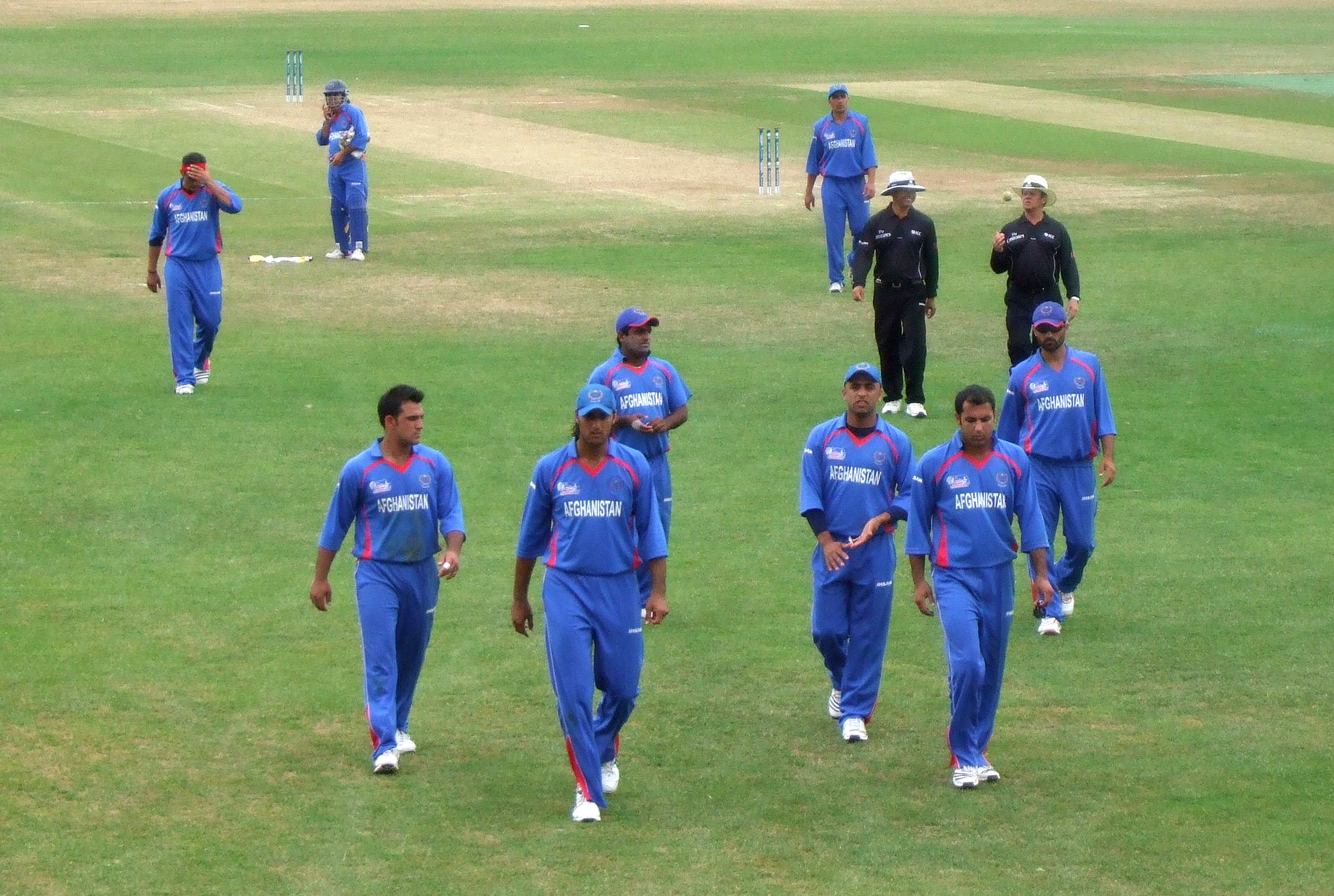
Archive photograph: Afghanistan’s men leave the field against Ireland in Rotterdam on July 3, 2010. Harrias, via Wikimedia Commons, CC BY-SA 3.0. Wikimedia version with levels adjusted by WikiPedant.
Talal Osman
Source: www.cricketscotland.com